I’ve been thinking a lot about the economics of services businesses and how AI changes the equation.
My view is that AI does not fundamentally change the forces that have always shaped services businesses.
It puts them on fast-forward.
That has important implications for how service businesses should think about technology, pricing, customer experience, brand, and ultimately what creates a durable competitive advantage.
Services Were Already Moving Toward Commoditization
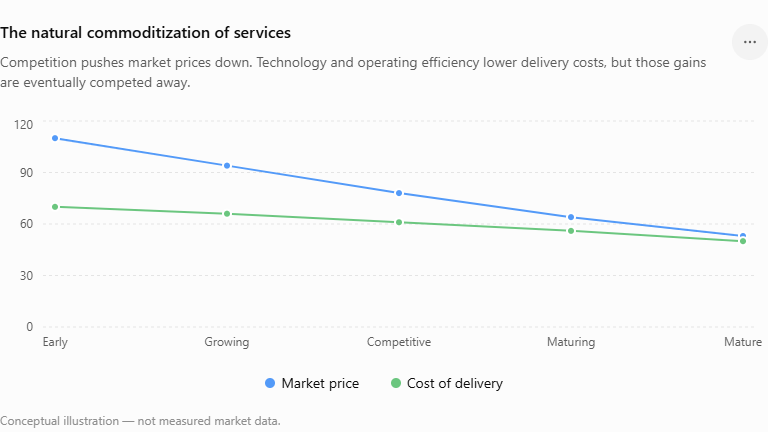
Even before AI, mature service categories naturally moved toward commoditization.
As more firms enter a market and the service becomes more standardized, differentiation gets harder. One firm quotes $10,000. Another quotes $6,000. Eventually, someone claims they can deliver essentially the same thing for $1,500.
Accounting is a particularly good example because buyers often cannot fully evaluate what they are buying.
Two firms may both sell “monthly accounting.”
One might primarily provide bookkeeping and transaction categorization with limited review. Another may be performing reconciliations, maintaining workpapers, reviewing accruals, implementing controls, managing financial operations, and producing substantially more reliable financials.
To the buyer, however, the outputs can initially look very similar.
The difference often does not become obvious until something breaks: the numbers are wrong, the company enters diligence, an audit begins, financing requires better reporting, or management needs to make an important decision using the financials.
When buyers cannot easily evaluate the quality of the inputs, they tend to overweight the thing they can evaluate most easily: price.
That creates structural pricing pressure.
Historically, service providers have had a few ways to respond:
- Become more efficient through technology, process, scale, or offshoring.
- Accept lower margins.
- Reduce the quality or scope of the service.
- Oversell what can actually be delivered.
Technology has always been central to the first option.
Software, automation, standardized processes, and global labor have steadily reduced the cost of delivering services.
But there is an important dynamic here:
Efficiency advantages do not stay advantages forever.
If one firm discovers how to deliver a service 20% more efficiently, it initially captures that benefit.
Over time, competitors adopt similar tools and processes. New entrants build around the new cost structure. Buyers begin to expect the savings.
Yesterday’s competitive advantage becomes tomorrow’s table stakes.
Over long periods, the market price and the cost of delivering a service both tend to move downward.
Historically, the strongest defenses against this have been things like brand, reputation, specialization, expertise, relationships, proprietary processes, and proprietary technology.
Those factors give the customer a reason to believe they are not comparing equivalent products—and therefore should not compare providers purely on price.
AI Puts the Services Race on Fast-Forward
AI dramatically accelerates this dynamic.
I think there are now effectively three different cost curves operating in the market.
1. Traditional Cost of Delivery
This is the cost structure of firms still operating primarily through legacy workflows.
These businesses will continue to become somewhat more efficient through traditional software and process improvements, but relatively slowly.
The firms that stay on this curve for too long risk eventually being competed away.
2. Actual AI-Enabled Cost of Delivery
This is what a sophisticated firm aggressively using the best available AI and automation can realistically achieve today while still delivering the work correctly.
Very few firms will operate at 100% of what is technologically possible.
Most will fall somewhere along a spectrum depending on how effectively they integrate AI into real workflows.
The gap between the traditional cost curve and this AI-enabled cost curve is what I think of as the:
Implementation Gap
This is the race most companies are currently talking about:
Implement AI → Automate work → Increase output per employee → Reduce cost of delivery
That race matters enormously.
But I think there is another race that may matter even more.
3. Perceived AI Cost of Delivery
This is what customers increasingly believe the work should cost because:
“AI can do all of this now.”
The issue is that customer expectations are often moving faster than what AI can reliably deliver in real-world environments.
There is still a meaningful difference between demonstrating an AI workflow and reliably operating that workflow across thousands of edge cases while maintaining the quality a customer expects.
The gap between what AI can actually deliver today and what customers think AI should be able to deliver is what I think of as the:
Expectation Gap
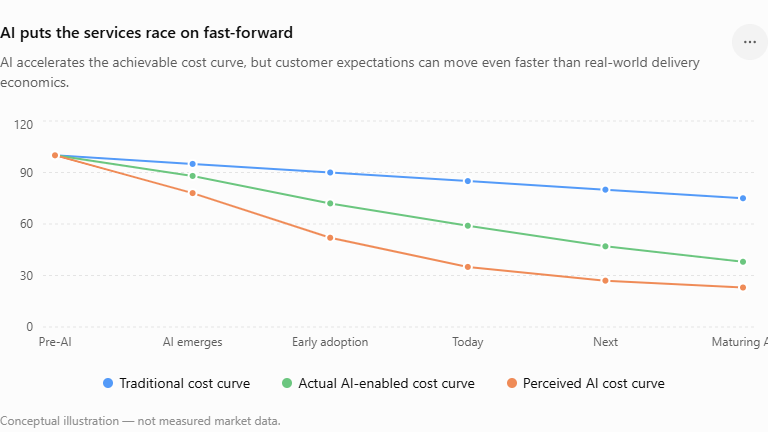
This helps explain some of the unusual pricing we are seeing in AI-enabled services.
Some businesses are effectively pricing closer to the perceived AI cost than the actual cost of providing the service.
There are a number of ways to do that temporarily.
They may be venture-backed and subsidizing delivery.
They may be intentionally sacrificing margin to gain market share.
They may be funding losses from another part of the business.
They may be reducing the actual scope or quality of the service.
Or they may simply be overselling what the technology can currently accomplish.
A dramatically lower price does not necessarily mean a provider has discovered a dramatically better cost structure.
Sometimes they are simply funding the gap.
That can still be strategically rational if it allows them to acquire meaningful market share before competitors catch up.
Getting to the AI Cost Curve Is Not the Moat
This leads to what I think is one of the most important implications.
Reaching today’s AI-enabled cost curve is not, by itself, a durable competitive advantage.
Using ChatGPT, Claude, agents, or other third-party tools better than competitors can create a meaningful advantage today.
But those tools keep improving, and everyone increasingly gains access to similar capabilities.
Proprietary technology can push a business even further down the cost curve or increase what it is capable of delivering.
That advantage matters.
But even proprietary technology has a half-life.
Competitors copy ideas.
Foundation models improve.
Third-party software absorbs formerly differentiated functionality.
Customer expectations move again.
So the model is not:
Implement AI → Become AI-enabled → Done
It is:
Adopt → Build → Gain an Edge → Edge Commoditizes → Build Again
Over and over.
The objective should not simply be to “implement AI” or build a handful of automations.
The objective is to build an organization capable of moving its own cost and capability curve faster than the market moves.
What This Means for GreenSpark
For us, that means using the best third-party AI wherever it makes sense while building proprietary intelligence where we believe there is meaningful additional value.
In accounting specifically, I do not think the long-term opportunity is simply processing more data.
Modern businesses already generate enormous amounts of data.
Transactions sit across banks, credit cards, Shopify, Amazon, retail partners, advertising platforms, inventory systems, payroll providers, lenders, and dozens of SaaS applications.
The harder problem is context.
A system may know that $100,000 moved.
But why did it move?
- Was it inventory?
- A deposit?
- A financing payment?
- A prepaid expense?
- A one-time operational issue?
An accountant may see an invoice, but not understand the business decision behind it.
And the operators who have that context are busy running the company. “Catch the accountant up” is understandably near the bottom of the priority list.
We think there is a significant opportunity to build technology that understands and connects that context.
That means helping answer questions like:
- Why is this number what it is?
- Should we trust it?
- What supporting data explains it?
- Does something look wrong?
- What changed operationally?
- What should the business do next?
That is the type of accounting intelligence we are increasingly interested in building.
The interface or dashboard is not really the point.
The intelligence underneath it is.
The goal is ultimately to complete more of the actual accounting and finance work—not simply give a human another tool that helps them work slightly faster.
If Technology Commoditizes, What Becomes the Moat?
Technology still matters enormously.
It determines what you can deliver.
It determines how much it costs you to deliver it.
It determines how quickly you can improve.
But if technology advantages continually commoditize, something else determines whether a business can actually capture the value it creates.
I think that something is brand.
And by brand, I do not mean a logo, website, or how many people have heard of the company.
Brand is the market’s accumulated perception of the value and experience of working with you.
For a services business, I think that comes down to six things.
1. Customer ROI — and Perceived Value
Actual value is not enough if the customer does not perceive it.
If one provider charges $10,000 and another charges $2,000, the $10,000 provider cannot simply be perceived as slightly better.
The customer needs to understand why spending the incremental $8,000 produces disproportionately more value.
That value is not limited to measurable cost savings.
It can include:
- Better decisions
- Fewer mistakes
- Reduced risk
- Faster execution
- Access to expertise
- Better financing outcomes
- Time saved
- Less management burden
Ultimately:
Customer ROI = Perceived Value ÷ Investment
The higher the price, the more perceived value the service needs to create.
2. Customer Experience
The experience of working with a firm becomes part of the product itself.
That means:
- High responsiveness
- Getting things right the first time
- Low friction
- Proactively identifying problems
- Requiring less input from the customer
- Making complicated things feel simple
One concept I increasingly care about is client effort.
The best service is not necessarily the one that gives the customer the biggest dashboard or the greatest number of reports.
It may simply be the one that requires the least work from the customer to achieve the outcome they wanted.
The customer should not need to manage the service provider in order to get value from the service.
3. Quality and Trust
This matters disproportionately in finance.
When we give a customer a number, they need to believe that it is right—or know that we can explain exactly why it is what it is.
Quality compounds into trust.
Trust compounds into brand.
This is also where technology should matter.
Better QA, traceability, context, supporting workpapers, and controls should not simply make the service cheaper to produce.
They should make the service more trustworthy.
4. Proof
Saying you are better does not create much differentiation.
Evidence does.
That includes:
- Customer outcomes
- Recognizable clients
- Case studies
- Referrals
- Testimonials
- Transactions completed
- Capital raised
- Problems solved
- Years of accumulated experience
Every successful customer creates evidence for the next customer.
5. Specialization and Expertise
Being great at “finance” is less defensible than becoming known as the finance and accounting team for a specific type of company.
For GreenSpark, our specialization in consumer brands matters.
Every additional consumer company we work with should increase our:
- Operating knowledge
- Pattern recognition
- Processes
- Data
- Technology
- Credibility
The more specialized we become, the more difficult it becomes for a generalist competitor to deliver an equivalent experience.
6. Market Share
Eventually, these advantages begin to reinforce each other.
More customers → More experience and pattern recognition → Better service and technology → More proof → Stronger reputation → More customers
At some point:
“They work with everyone in our industry.”
becomes a competitive advantage by itself.
And that may ultimately become one of the hardest advantages for a competitor to break.
AI Should Not Just Make You Cheaper
This brings everything back to pricing.
I do not think the goal should necessarily be to race price downward alongside the cost curve.
If technology allows a company to deliver a $10,000 service for $5,000 of internal cost instead of $8,000, it has several choices.
It can lower the price.
It can capture more margin.
It can increase what it delivers.
Or it can do some combination of all three.
There may absolutely be periods where passing efficiency through to the customer makes strategic sense—particularly if doing so accelerates market-share gains.
But continuously converting every efficiency gain into a lower price simply puts the company back into the commoditization race.
The better long-term outcome is to use technology to increase customer ROI and company margin simultaneously.
Don’t Use AI Just to Become Cheaper. Use AI to Become Disproportionately Better for What You Charge.
That is ultimately the equation I think matters.
Technology determines your cost and capability curve.
Brand determines how much of the value you create you are able to capture.
And the companies that win the AI-enabled services race will likely be the ones that become exceptional at both.